
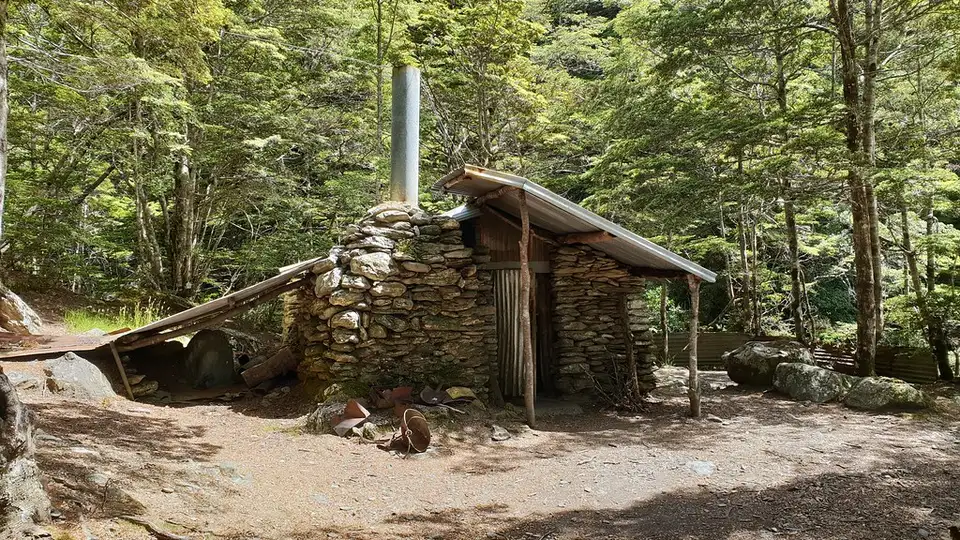
Sam Summers' Hut
A schist prospector's hut built in 1930 on Twelve Mile Creek, an hour's walk from the Glenorchy road. Day visits only, and still standing when every shelter around it has gone.
Sam Summers and his brothers built this hut in 1930, out of schist and iron, up Twelve Mile Creek behind Mount Creighton. It was not built to be visited. It was shelter against the weather while they sluiced for gold, and Sam lived and prospected along this creek for about ten years.
What makes it worth the walk is that it is still here. Every other prospector's shelter in the valley has come down to a wall base or a chimney. This one has been repaired and maintained for the better part of a century, and you can put your head through the door and see the bunks.
Getting there
The hut is on the Mt Crichton Loop Track, which starts from the car park on the Glenorchy road twelve kilometres from Queenstown. Allow about an hour return for the walk to the hut and the waterfall, or 2 to 3 hours for the full loop. It is graded easy.
There are old mine shafts and steep drop-offs beside the track. The bridge at the Māori Gully confluence was destroyed in a flood and has not been replaced, so do not cross the creek if it is high or discoloured.
Day visits only
You cannot sleep here. Overnight stays have not been permitted since 1 December 2021, and fires are not allowed at any time — which is worth taking seriously in a hundred-year-old timber-and-schist building in the middle of a beech forest. There is a toilet at the hut.
It is a historic site rather than a backcountry hut. Take your rubbish, leave the artefacts where they are.
Sam
Sam was one of eleven — a sister and nine brothers — and he helped provide for them by prospecting and hunting, with a vegetable garden and strawberry beds near the hut. The family walked in from Closeburn Station to stay, and his younger siblings came up often. His sister Betty remembered making toffee over the open fire, and Sam carrying the children piggy-back through the creeks, because there were no bridges then.
He left the hut to go to war and came back to visit for the rest of his life, often walking the whole way from Queenstown. He died in 1997 at 92, nearly blind and independent to the end.
The wider valley
The interpretation panel at the hut sets it in a sequence that repeats all over this district.
- Early miners, about 1863 to 1870. Almost nothing left. Later mining and time have wiped out the traces.
- Chinese miners, about 1870 to 1885. The remains of two Chinese huts sit above Sam's hut. Artefacts and travel records point to a sizeable Chinese population working this creek.
- Later miners, about 1900 to 1940. Wall bases, chimneys and fireplaces mark where European miners kept at the gold. Many of those sites date from the Great Depression, when work was scarce and mining was subsidised. Sam and his brothers were part of that.
There is more on the same history at Arrowtown, where the Chinese settlement has been restored, and along the Shotover and Kawarau rivers.
Photo Gallery
